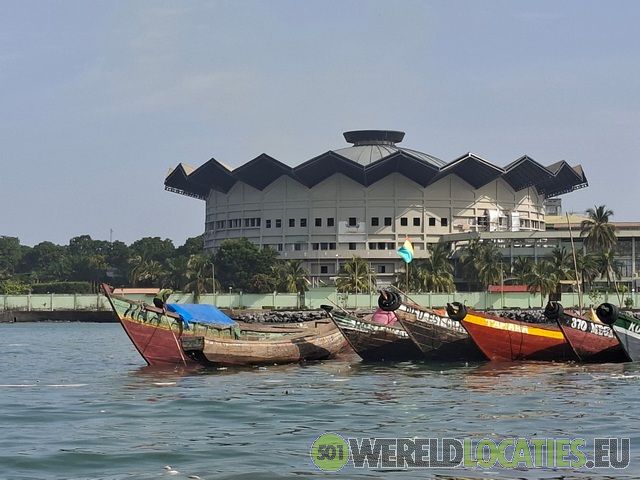
Foto: The Presidential Palace (bron: Ronald van der Veer)
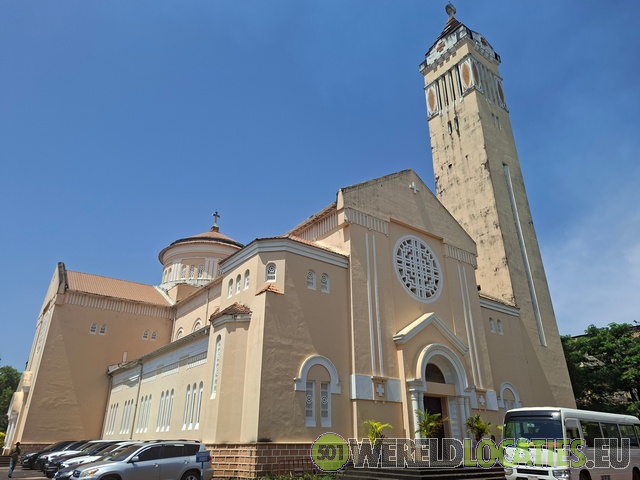
Guinea - We then take the bus to the National Museum. This modest museum explains that Guinea consists of four regions, each with its own distinctive features in terms of traditional thatched huts, musical instruments and crops. In front of the museum stands a statue of Ahmed Sékou Touré, the first president of independent Guinea, which gained independence in 1958. After visiting the museum, we drive to the cathedral. The Cathédrale Sainte-Marie of Conakry was built during the French colonial period. Construction began in 1928. Inside, the church looks rather plain. The cathedral is located close to Place des Martyrs de la Guinée. I am not allowed to walk over there to take a photograph, as the square is next to the Presidential Palace. We then drive to the Monument du 22 Novembre. This memorial column commemorates the repelling of the Portuguese attack on Guinea in 1970. Portugal wanted, among other things, to put an end to Guinea's support for the independence fighters in neighbouring Guinea-Bissau. At around half past one, we arrive at the restaurant where we are going to have lunch. The interior of this upmarket restaurant is busy. I suspect most of the customers are expats. In any case, it is certainly not the cheapest restaurant in town. I had already let them know yesterday that I would like to order French onion soup. Even so, it takes a long time for the food to arrive. Interestingly, those fellow travellers who order something on the spot receive their food earlier. Most of these orders are desserts, incidentally. The long wait is not really a problem, as the acrobatic performance by local youngsters is not scheduled to start until four o'clock. We even have time to return to the hotel for a while. I rather like that, because in this heat I would be happy to change my shirt. Back at the hotel, we discover that one of the lifts is out of service for maintenance. The other lift is extremely slow. The receptionist points us towards the emergency staircase. Unfortunately, the door on the second floor can only be opened from the inside. So the lift is our only option for getting upstairs. Once I reach my room, I discover that my key does not work. Sigh! At least I can now take the stairs back down to reception. Because of this delay, I eventually make it back just in time for our departure to the acrobatic performance. Acrobatics is a lively part of street culture in Conakry. For street children, the sport offers a possible way out of poverty. When we arrive at the hall where the youngsters are performing, everyone is milling around. Chairs are quickly set up for us, and the show begins. Energetic drum rhythms accompany the boys and girls as they take turns dancing and doing forward rolls. This is followed by somersaults, a fire-breather and a balancing act. The show is professionally organised, and the dancing is perfectly synchronised. At the end, the youngsters build a human tower three people high. The top acrobat balances on his head at the very top of the tower. For the final act, we are invited to join in the dancing. Fortunately, they adapt the dance so that we don't have to take part in any acrobatics. The performance has pleasantly surprised me! Afterwards, we stop at a market selling handicrafts and souvenirs. I order a Coke and sit down on a low wall. Before long, a woman approaches me asking for money. When one of my fellow travellers walks past, she follows him towards the bus. There, she continues pestering him for money in a rather unpleasant manner. When the driver tries to push her away, a pushing and shoving match breaks out.