

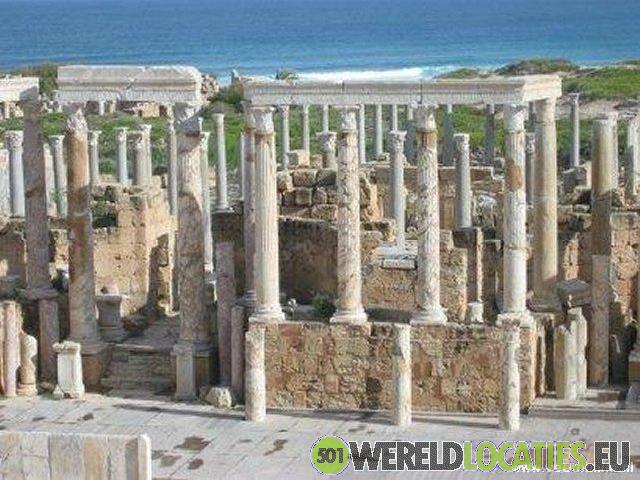
Foto: The ruins of Leptis Magna (bron: Guy Vancraybex)
Libya - Leptis Magna is a Phoenician-Roman city in North Africa, located in present-day Libya, near the town of Al Khums. It was situated on the Mediterranean Sea and the Wadi Lebda, a few kilometers west of the mouth of the river Cinyps (now known as the Wadi Qaam). It was the capital of Tripolitania in the Roman province of Africa. Tripolitania was named after the Greek term treis poleis, meaning “three cities.” These three cities — Sabratha, Oea, and Leptis Magna — were the most important in the region. The name Leptis Magna was used to distinguish it from Leptis Parva in present-day Tunisia. The city is believed to have been founded as a Phoenician settlement around the 11th or 10th century BC. According to the Roman writer Sallust, the settlers came from the city of Sidon. However, it likely became a fully developed city around 600 BC. It was heavily influenced by another major Phoenician city, Carthage. For example, Leptis Magna paid tribute to the Carthaginians — one talent per day. After the destruction of Carthage, Leptis remained an important port city, and the Romans gained control over North Africa. Leptis Magna retained a degree of independence, but its city council had to report to the Roman Senate.
