


Foto: The Narrow Streets of El Atteuf (bron: Ronald van der Veer)
Algeria - Ghardaïa is a Berber oasis town and forms the heart of the M’Zab Valley. The fortified sister towns of Melika, Beni Isguen, Bounoura, and El Atteuf are also located here. We first visit the oldest of the five towns: El Atteuf, founded in 1012. Over the centuries, the town was expanded several times with additional walled quarters. Hossein, our guide for today, emphasizes that we should not take photographs of the people, as this is not appreciated—especially the women completely veiled in white. According to local tradition, they are fully covered; only one eye remains visible. It looks rather unusual, even more extreme than a burqa or niqab. In El Atteuf, we meet Isa, the local guide for this town. He leads us through the narrow and often covered streets and alleyways. We climb stairways that bring us higher into the town. The higher you go, the older the neighborhoods, Isa explains. The houses are still inhabited today. Every little street is beautiful, and it’s no wonder the M’Zab Valley is listed as a UNESCO World Heritage Site. At the very top of the town stands the old mosque of El Atteuf. The door is closed, but I can see the earthen minaret. The tower tapers toward the top to better withstand the wind, Isa explains. A little further on, we visit a traditional house. I see dozens of shoes at the entrance. Inside is a group of twenty children listening attentively to an explanation. Their attention shifts as soon as we enter. Isa continues his story right through the instruction being given to the children, which feels a bit awkward. When the boys leave the house, we are allowed to take photos as well. Isa points out a narrow slit in the wall—through this small opening, women can look outside without being seen from the street. Women here have very little influence. At the edge of the town lies the old cemetery. Depending on which side of the double stone is placed, the grave belongs to a man or a woman. It looks somewhat chaotic. Isa tells us that the new cemetery is located outside the town. At the foot of the hill stands the Sidi Brahim Mosque, one of the oldest religious buildings in the M’Zab Valley. The mosque is built of mud and lime plaster, with soft, rounded forms and a striking minaret. We have to wait a moment until a family finishes their prayers. Here too, women pray separately in a small enclosed space. After El Atteuf, we drive to Ghardaïa. On the way, we stop at a viewpoint overlooking Bounoura. In Ghardaïa, we visit the market. Hossein tells us several times that Fridays are very quiet because of the Friday prayers. Still, a few stalls and shops are open. We follow him through the covered market streets. At a butcher’s stall lies a camel’s head on the counter; presumably the rest of the meat is also processed here. For lunch, we stop at a small kebab restaurant. Just like yesterday, it is chaotic. A table is moved for us, though why it has to be directly in front of the kitchen door is unclear. I order two chicken skewers and fries. A little later, however, two chicken legs arrive—far too much. These go back. When we want to pay, the waiter seems confused. He does not know exactly what we had. “Later,” he says. First he is going to pray. We are not going to wait here for that. Hossein suggests that we return this afternoon to settle the payment. We drive to Beni Isguen, the hometown of Mustafa and Hossein. Here, as well, visitors may only walk around accompanied by a guide. Since Hossein is from this town, he can lead us. We start at a small museum, then wander through the narrow streets that lead uphill to the oldest part of the town. Here too, every street looks picturesque. At the top, we have a view over the valley and the various surrounding towns. What an extraordinary environment.


Roman Ruins of Djemila

Algeria - The ancient Roman city of Djémila, originally named Cuicul, was founded in the first century AD. It was initially populated by former soldiers from the Third Legion of Augustus and grew into an important regional economic hub. The city's prosperity was ...
Tassili NAjjer National Park
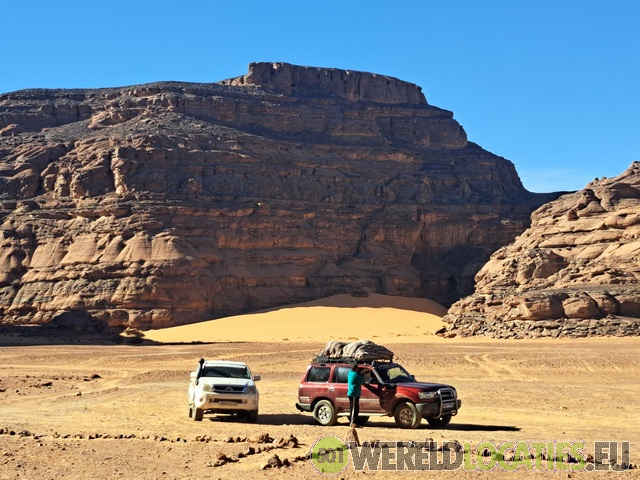
Algeria - At ten o’clock, we meet the crew for the coming days: a guide, a cook, and two drivers. The luggage goes into one vehicle, while the supplies are loaded in the back of a pickup truck. We divide ourselves between the two cars and drive out of Djamet. ...
The Hanging Bridges of Constantine

Algeria - I had expected that today we would walk to the old center of Constantine, but the distance turns out to be too far. Instead, we drive by minibus to the Emir Abdelkader Mosque. After independence, this mosque was built in 1972 to accommodate about 20,000 ...
The Kasbah of Algiers

Algeria - In the seventeenth century, the Spaniards attacked Algiers. The Algerians called for help from the Ottomans. This led to present-day Algeria becoming part of the vast Ottoman Empire, although the country retained a special status. The Beys became the ...
The Roman City of Tipaza
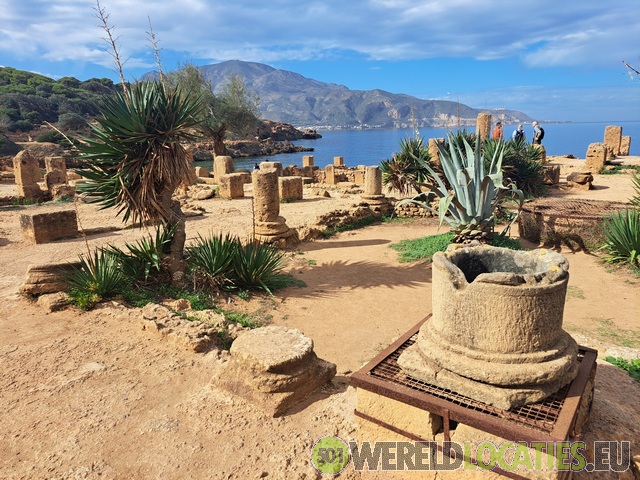
Algeria - A little later, Leila comes walking toward us. She guides us to the two Roman cities. Leila explains that we will first drive to Cherchell, the farthest city from Algiers. During the French colonization, many historic Roman buildings were demolished and ...
Timgad the Pompeii of Africa

Algeria - Just after midday, we arrive in Timgad. Timgad is a large Roman archaeological site and the best-preserved Roman city in this region. Because part of the remains ended up buried under a thick layer of desert sand, the city is often referred to as the ...