


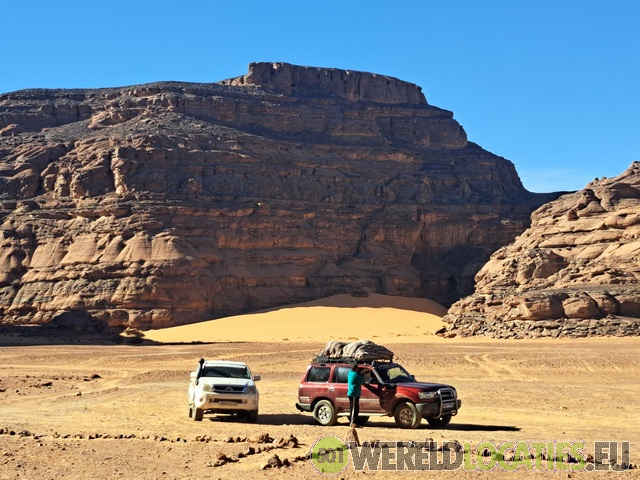
Foto: The Stunning Sahara Desert (bron: Ronald van der Veer)
Algeria - At ten o’clock, we meet the crew for the coming days: a guide, a cook, and two drivers. The luggage goes into one vehicle, while the supplies are loaded in the back of a pickup truck. We divide ourselves between the two cars and drive out of Djamet. Ibrahim, our guide, explains that about 20,000 people live in Djamet, but an additional 15,000 soldiers are stationed in the area to guard Algeria’s borders with Libya and Niger. Just outside the town, we drive onto a paved road leading into the desert. On both sides, there is mostly sand and rocks. We make a brief stop at a road sign indicating the split toward Libya or Niger—a funny choice. Today, we are heading to Tassili N'Ajjer National Park, which lies mostly in Algeria but stretches slightly into Libya. Around noon, the drivers turn the vehicles off the asphalt road and into a valley. We pause under a tree while the crew prepares lunch for us. In the meantime, we stroll around a bit. The sun isn’t too strong, and clouds hang in the sky, keeping the temperature moderate. On the ground, we find small round fruits the size of tennis balls that look like tiny watermelons. We play a few rounds of pétanque with the fruits. Lunch is then ready: vegetables, meat, and salad. Afterward, there is tea—sweet tea. The tea is poured from a high arc, creating a layer of foam on top. We are told that this foam prevents sand or flies from getting into the tea. The crew takes their time, and we only depart around two o’clock, giving us a chance to relax a little. After the lunch break, we drive a short distance on the asphalt road, then turn off and continue through the sand. The drivers try to find the best track, sometimes creating a new one themselves. I had expected we would follow existing desert paths, but the surroundings become increasingly beautiful. However, it also grows cloudier, and the sun disappears. Ibrahim explains that Tassili N'Ajjer National Park has three entry routes: east, central, and west. We take the central route and will return via the eastern side in five days. Late in the afternoon, we search for a place to spend the night. Behind a rock, sheltered from the wind, the crew sets up the camp. I am given a tent to set up—a pop-up tent. I release it, and it unfolds automatically. I place a mat and my luggage inside. Meanwhile, the crew prepares tea.


Roman Ruins of Djemila

Algeria - The ancient Roman city of Djémila, originally named Cuicul, was founded in the first century AD. It was initially populated by former soldiers from the Third Legion of Augustus and grew into an important regional economic hub. The city's prosperity was ...
The Cities in the MZab Valley

Algeria - Ghardaïa is a Berber oasis town and forms the heart of the M’Zab Valley. The fortified sister towns of Melika, Beni Isguen, Bounoura, and El Atteuf are also located here. We first visit the oldest of the five towns: El Atteuf, founded in 1012. Over ...
The Hanging Bridges of Constantine

Algeria - I had expected that today we would walk to the old center of Constantine, but the distance turns out to be too far. Instead, we drive by minibus to the Emir Abdelkader Mosque. After independence, this mosque was built in 1972 to accommodate about 20,000 ...
The Kasbah of Algiers

Algeria - In the seventeenth century, the Spaniards attacked Algiers. The Algerians called for help from the Ottomans. This led to present-day Algeria becoming part of the vast Ottoman Empire, although the country retained a special status. The Beys became the ...
The Roman City of Tipaza
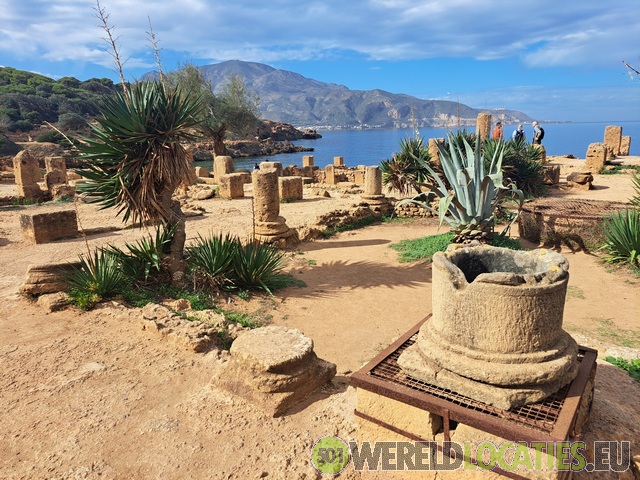
Algeria - A little later, Leila comes walking toward us. She guides us to the two Roman cities. Leila explains that we will first drive to Cherchell, the farthest city from Algiers. During the French colonization, many historic Roman buildings were demolished and ...
Timgad the Pompeii of Africa

Algeria - Just after midday, we arrive in Timgad. Timgad is a large Roman archaeological site and the best-preserved Roman city in this region. Because part of the remains ended up buried under a thick layer of desert sand, the city is often referred to as the ...